


U.S. tariffs take center stage but China and the EU are quietly clashi
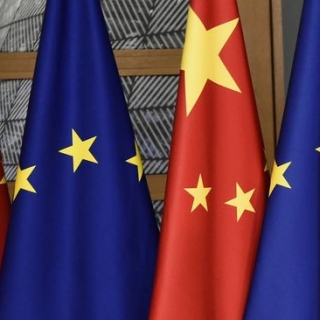
The U.S. tariff saga has stolen global spotlight from trade tensions between China and the European Union, which are now heating up.
Accusations and investigations over each other's trade practices have long been a staple of EU-China trade relations, underpinned by concerns over how domestic economies are likely to be impacted by competing imports.
In recent weeks, EU restrictions on Chinese companies taking part in public tenders for medical devices were quickly met with China imposing import curbs on such products. Separately, long-threatened Chinese duties on brandy from the EU came into force earlier this month, and both Beijing and Brussels have ramped up criticism of each another.
Altogether, EU-China trade relations are now "quite poor," according to Marc Julienne, director of the Center of Asian Studies at the French Institute of International Relations (Ifri).
"What was once a domain of great opportunity and enthusiasm for the bilateral relationship has now become more about risks than opportunities," he told CNBC earlier this week.
EU and China relations are encumbered by many challenges and risks often linked to clashing economic positions, Grzegorz Stec, senior analyst at the Mercator Institute for China Studies, suggested.
"The EU and China are broadly on a colliding trajectory in terms of their trade and industrial policy concerns," he told CNBC. Bones of contention include the challenge of China's overcapacity and trade diversion to Europe, Stec, who is also head of the Mercator Institute's Brussels office, explained.
"Beijing's increasingly pressing need to export contradicts the EU's need to protect its own industrial base," he added.
China's economy is facing a gap between its production capacity and demand. It is also struggling with sluggish growth, while exports, which long boosted the economy, have been under pressure amid global trade tensions and lower demand.
Ifri's Julienne also flagged a series of concerns that make the EU-China relationship tricky, including an increasingly difficult environment for foreign companies operating in China and Europe's growing trade deficit. Additionally, he said Beijing was "weaponizing" trade to put pressure on Europe — like they did with the brandy tariffs.
China first started investigating European brandy imports after the EU began slapping levies on Chinese-made electric vehicles last year, which pose steep competition to Europe-made alternatives.
U.S. tariffs impacting EU-China relations
U.S. President Donald Trump's recent tariff regime could have been an opportunity for China and the EU to improve their relations, according to Ifri's Julienne.
"It should have had a positive impact on the bilateral relationship, in the sense that facing economic coercion from the United States [the EU and China] might have been expected to negotiate and compromise in order to make the most of their trade relationship amid the US tariff war," he said.
Jean-Marc Fenet, senior fellow at the ESSEC Institute for Geopolitics & Business, suggested one reason for this failure could be that Beijing feels it has come out on top in its own trade drama with Washington.
"The need for a common front with the EU is therefore less necessary," Fenet said. "In fact, the fear now in Beijing is rather that the EU will accept an alignment with an anti-Chinese line that the American administration would impose on the sidelines of the trade negotiations."
Source: CNBC
Renewed tensions between the United States and Russia have resurfaced following an incident involving an oil tanker, sparking market concerns about potential disruptions to global energy supplies. Was...
According to a report from the US Department of Labor (DOL) released on Thursday, the number of Americans filing new applications for unemployment insurance rose to 208,000 for the week ending January...
Geopolitical issues have heated up again after statements and political signals from the United States sparked speculation about a possible US takeover of Greenland. Although no concrete action has be...
Private employment rose less than economists expected in December, according to the ADP report. Private employment rose 41,000 (Estimate +50,000) in December, compared with a revised -29,000 in Novem...
Greenland is not only a strategic location, but also a world-class mineral repository. The island holds vast reserves of rare earth elements (REEs), essential for modern technology. These minerals are...
Oil prices stabilized on Thursday (February 12th), as the market reassigned a risk premium to US-Iran tensions despite US inventory data showing swelling domestic supplies. This movement confirms one thing: geopolitical headlines are still more...
Gold prices weakened slightly on Thursday (February 12th), as more solid US employment data reduced market confidence in an imminent Federal Reserve interest rate cut. The strong employment data prompted market participants to shift expectations of...
The Hang Seng Index reversed its downward trend in Hong Kong on Thursday (February 12th), weakening by around 0.9% to around 27,000 after a strong session earlier. This decline halted the momentum of the short term rally, as investors began to...